How Much Backup Do 150Ah and 200Ah Batteries Really Give? My Lab Tests, in Plain Words
I discharge-tested 150Ah and 200Ah tubular batteries at real home loads and logged every minute. Here is what each battery actually delivers, why heavy loads silently destroy battery life, and why light-load users top up water less and get years more service.
In one line: Your battery label is a promise measured under conditions your home will never see. At 400W, a 150Ah battery actually behaves like a 93Ah battery. And the harder you load it, the faster it loses water and the sooner it dies. I measured all of this — here is the data.
Every family that buys an inverter battery in India asks the same question: how many hours of backup will I get? And every dealer answers from the same brochure chart — capacity × voltage ÷ load. By that arithmetic, a 150Ah battery should run a 400W load for four and a half hours.
I have spent thirty years discharge-testing batteries. The real answer, measured in my lab with a logger recording every few minutes: 2 hours 50 minutes. The brochure is not lying about the battery. It is lying about your home.
This article shows you, in plain words, what a 150Ah and a 200Ah tubular battery actually deliver at real household loads — and something the brochure never mentions: what those loads do to your battery's life and water consumption.
How I Tested
No formulas, no simulation. A healthy, fully charged tubular battery. Resistive bulb loads from 400W to 1400W, running through a standard Indian home inverter — so every number below already includes the inverter's conversion losses. The inverter's low-battery cutoff was the standard 10.5V. A logger recorded battery voltage and current every 5–15 minutes until the inverter switched off. I ran the complete load ladder on a 12V/150Ah battery and verified key loads on a 12V/200Ah battery in March 2021.
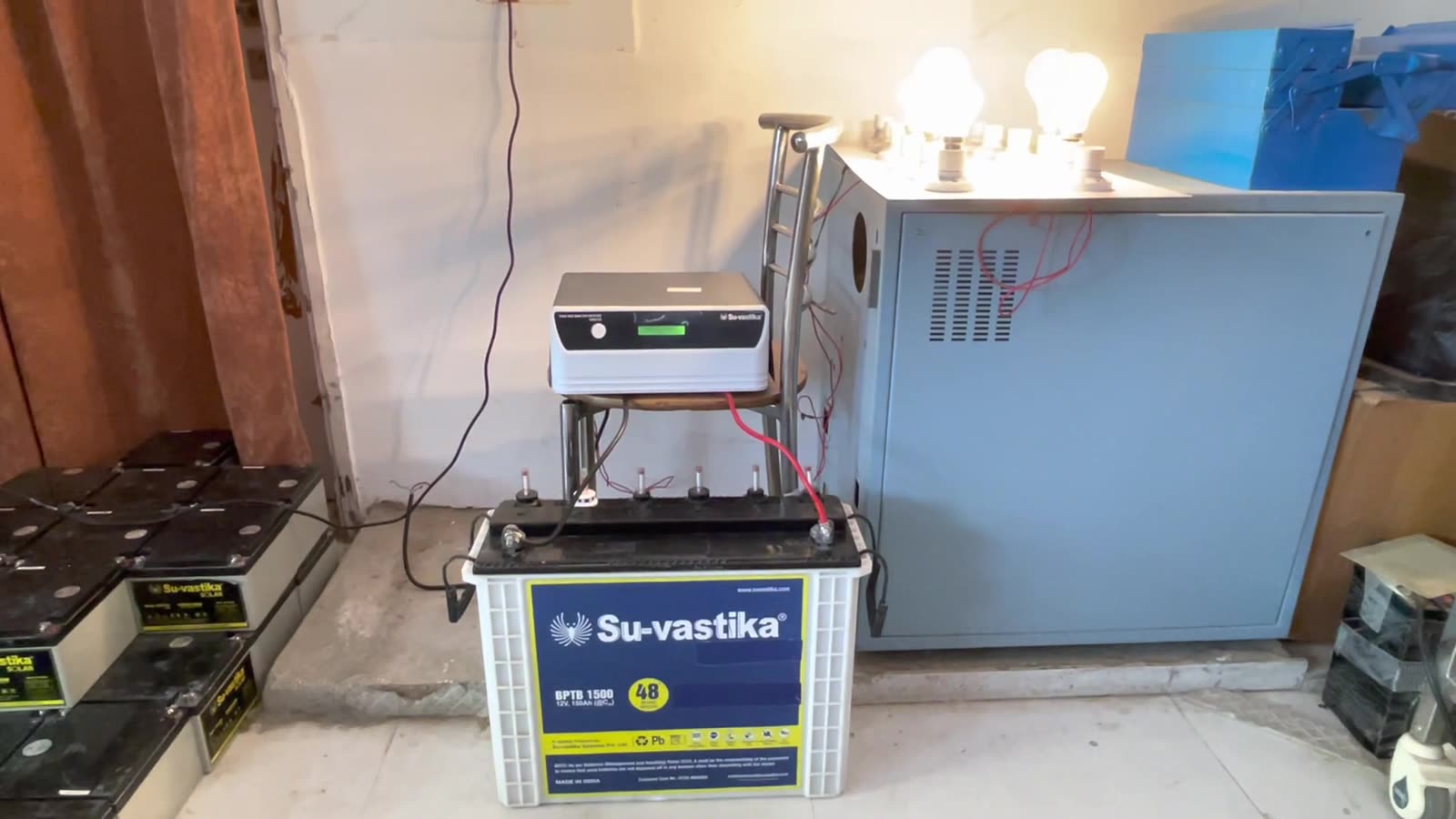
This is not a stock photo — this is the actual test running. The 12V/150Ah tubular battery, the inverter, and the bulb load board it is feeding:
Live discharge test: bulb load running on the 150Ah tubular battery through a home inverter.
A note on the battery you see in the video: it carries the Su-vastika brand, from the period when these tests were logged. Su-vastika stopped manufacturing lead-acid batteries in 2020. The findings in this article are about tubular lead-acid chemistry itself — they apply equally to every brand of tubular battery sold in India today.
The 150Ah Battery: What It Actually Gives
| Load | Measured backup | Ah delivered | Drop from label |
|---|---|---|---|
| 400W | 2h 50m | 93 Ah | −38% |
| 600W | 1h 30m | 79 Ah | −47% |
| 800W | 1h 00m | 64 Ah | −57% |
| 1000W | 40 min | 52 Ah | −65% |
Read that last column slowly. The battery does not merely run for less time at a higher load — that would be natural. It delivers less total energy. At 1000W, two-thirds of the capacity you paid for never comes out of the case.
The 200Ah Battery: Same Story, Bigger Stage
| Load | Backup | Ah delivered | Drop from label |
|---|---|---|---|
| 400W | 4h 20m | 149 Ah | −25% |
| 600W | 2h 26m | 119 Ah | −41% |
| 800W | ~1h 30m | ~103 Ah | −49% (estimated) |
| 1000W | ~1h 05m | ~88 Ah | −56% (estimated) |
The 400W and 600W rows are measured directly from my March 2021 lab logs; the 800W and 1000W rows are estimated from the measured curve, and a separate 1100W test (80Ah delivered) confirms the estimates are accurate within a few Ah.
Notice the pattern: the 200Ah at 600W behaves almost exactly like the 150Ah at 400W. Same stress, same surrender. A battery does not care about watts alone — it cares about watts relative to its size.
Both Batteries, One Picture
Put the two batteries side by side and the message becomes impossible to miss: the percentage of the label you actually receive falls steadily as the load climbs — for both batteries, in the same way. The 200Ah simply enjoys a head start because every load is lighter work for it.
Notice also what the gap between the lines is worth in real terms: at 400W the 200Ah hands you 56Ah more than the 150Ah; at 1000W the gap is still 36Ah — but by then the 150Ah is barely a third of its label. The heavier your load, the more the bigger battery justifies its price.
The Comfort Zone: Where Lead-Acid Is Happy
After three decades of testing and field experience, I can draw a simple line for you.
A 150Ah battery is comfortable up to about 300W. Below this, the chemistry keeps up with the demand, the battery delivers its best percentage, and it runs cool.
A 200Ah battery is comfortable up to about 400–500W. Same chemistry, bigger plates, more current available without strain.
Beyond the comfort zone, the battery still works — my tables above show exactly how long. But you are no longer using the battery. You are stressing it. And stress has two costs the brochure never mentions.
The Hidden Costs: Water Loss and Battery Life
Here is what thirty years of field experience taught me, and what no backup chart shows.
Heavy loads make the battery lose water faster. High discharge current heats the battery from inside. Then the inverter recharges it at high current to refill the deep discharge — more heat, more gassing, more electrolysis splitting your distilled water into hydrogen and oxygen. The water level drops. This is not a defect; it is physics. But it means the user with a 1000W load on a 150Ah battery is topping up water every few months, while the user running 300W on the same battery barely touches the vent caps from one year to the next.
Heavy loads shorten battery life. Frequent deep discharges at high current shed active material from the plates, warp them with heat cycles, and expose the plates whenever the water runs low between toppings. In my experience, the light-load user gets the best years out of a tubular battery — often the full design life and more. The heavy-load user comes back to the market years early, blames the brand, and buys the same undersized setup again.
Watch your own water topping frequency — it is the battery telling you about your loading. Rare topping means a comfortable battery and a long life. Frequent topping means your battery is being worked too hard, and it is aging fast.
What This Means When You Buy
Count your real load first. Fans, lights, TV, refrigerator, router — add the watts. Most Indian homes' essential load is 300–600W.
Then size the battery so your load sits inside the comfort zone. Essential load near 300W: a 150Ah serves you well. Load of 400–500W: choose the 200Ah. The price difference buys you more than backup hours — it buys you fewer water toppings and years of extra life.
For loads near 1000W and above, do not push one 12V battery — add batteries. A 1200W load on a single 150Ah gives roughly 25 minutes. The same load on a 24V bank of two 150Ah batteries gives about 1 hour 40 minutes in my testing — four times the backup from twice the battery, because each battery now lives inside its comfort zone. This is the single most misunderstood fact in inverter sizing.
I have built my measured test data — not brochure formulas — into a free tool: the Battery Backup Time Calculator. Enter your battery and your appliances, and it interpolates directly from the tests in this article.
One final caveat: everything above assumes the Ah printed on your label is honest. In India's unorganised battery segment, it frequently is not. A dishonest label defeats honest measurement every time.
Test conditions: resistive bulb loads through a standard home inverter, healthy fully charged C20-rated tubular batteries, low-voltage cutoff 10.5V, voltage and current logged at 5–15 minute intervals until cutoff. 150Ah: full load ladder. 200Ah: 400W/600W/1100W runs logged March 2021; 800W and 1000W figures interpolated from the measured curve.
⚡ © 2026 Kunwer Sachdev · Original discharge test data & methodology · inverterindia.com · All rights reserved
